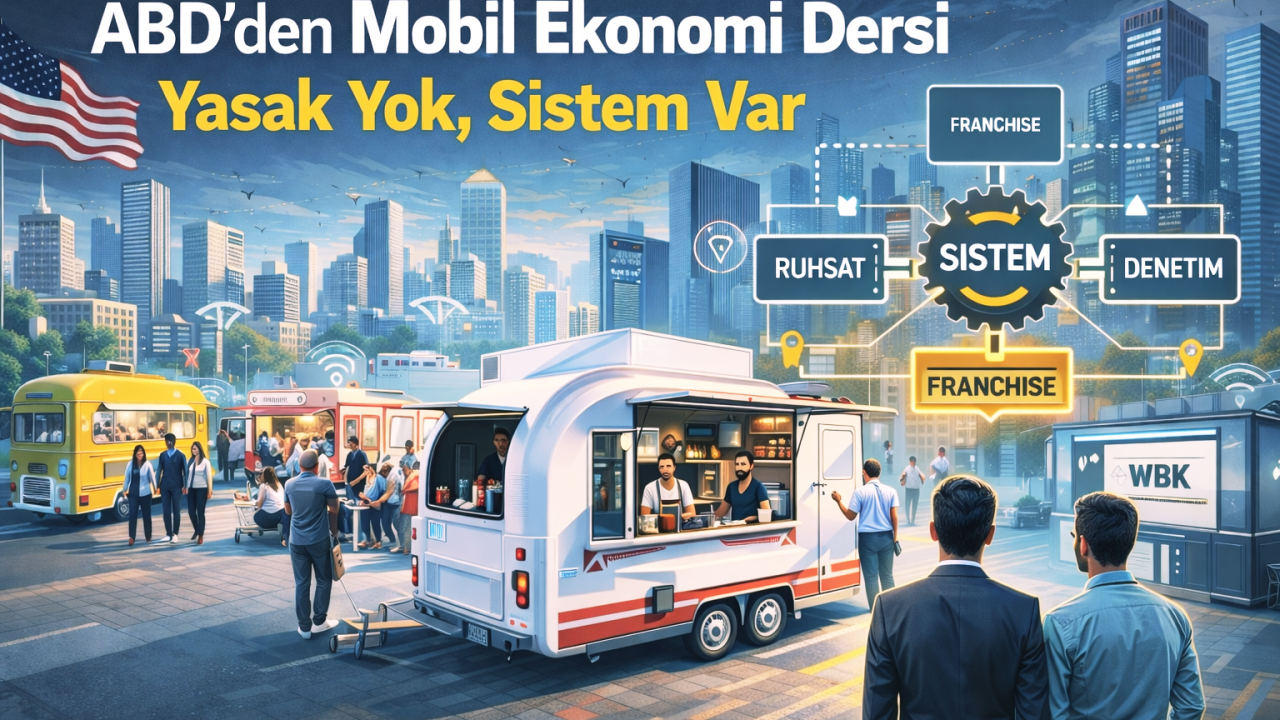
Mobile entrepreneurship franchise models and a systems approach for a sustainable registered economy.
The Wrong Basis for the Debate
The gig economy is a topic of debate in many cities today. Some view these activities as disruptive, temporary, and unregulated; others argue that they should be left completely unregulated. Yet successful examples show that the gig economy cannot be managed by either banning it or leaving it completely unregulated. The real issue is ensuring that mobile businesses can coexist in balance with public spaces, existing merchants, and public authorities.
High rental costs, long-term leases, and economic uncertainty are driving entrepreneurs toward more flexible models. Mobile units offer a strong alternative here. Low startup costs, quick transition to operations, and the ability to test demand at different locations enhance their appeal. However, without proper governance, these advantages can quickly turn into problems.
The U.S. Model: Integration, Not Prohibition
In the U.S., local governments have chosen to integrate mobile businesses into the system by regulating them rather than banning the dynamism they create. From food trucks to mobile coffee stands, and from mobile service vehicles to maintenance services, many models operate within specific rules.
Mobile businesses are being made licensed, permitted, digitally registered, and subject to oversight. Municipalities clearly define where, at what times, and under what technical standards mobile vehicles may operate. Through time limits, zoning, and designated mobile zones, both traffic flow and the balance of local businesses are maintained. By preventing vehicles from remaining at the same location continuously, unfair competition with brick-and-mortar businesses is avoided.
As a result, mobile and brick-and-mortar commerce become complementary rather than competitors.
Records, Data, and Tax Aspects
The most critical aspect of the mobile economy is its capacity for data collection. In the U.S., mobile businesses are largely managed through digital applications, online permits, and real-time tracking systems. Activity duration, location, and sales data can be tracked.
This structure expands the tax base, reduces audit costs, increases data production, and improves policy quality. When designed correctly, the mobile economy is not a problem area but a source of public revenue and data.
Franchise and Branded Systems Segment
The mobile economy is no longer limited to individual entrepreneurs. The U.S. example shows that mobile business models are rapidly scaling through franchises and branded systems.
Mobile coffee, dessert, quick-service, and service concepts are now growing with brand standards, operational guidelines, and internal audit mechanisms.
This structure also creates advantages for the public sector. A dual-layer control system emerges: public oversight and brand-internal oversight.
Entrepreneurs gain brand assurance, the public sector has a point of contact, and quality becomes scalable. The mobile economy thus transitions from an individual livelihood model to a corporate business model.
The Balance Between Public Space and Small Businesses
In U.S. cities, mobile vendor locations are managed through zoning. Random parking is prohibited. Parking lots, campuses, event areas, and festival grounds are encouraged for mobile businesses.
Long-term operations in front of brick-and-mortar businesses are prohibited in most places. Distance rules, time limits, and rotational use are enforced. This prevents unfair competition and preserves commercial balance.
Mobile and stationary commerce together create a sustainable ecosystem.
Audit and Technical Standards
Criteria for hygiene, waste management, noise levels, energy consumption, and environmental impact have been established for mobile businesses. Food and personal care services are subject to inspections similar to those applied to brick-and-mortar businesses. This transforms the mobile economy from a “temporary” sector into a serious and disciplined field of business.
Crisis and Resilience
The mobile economy enhances urban resilience during times of crisis. It enables rapid adaptation in situations such as disasters, major events, sudden population movements, and infrastructure shortages. It serves as a testing ground for pilot projects. For this reason, mobile models have become an integral part of public planning in many cities.
The Lesson from the U.S. Model
The message is clear: The mobile economy is not a law enforcement issue, but a matter of system design.
With low-cost permits, designated areas, clear time limits, and a digital registration system, many activities currently considered street vending could become registered micro-enterprises tomorrow.
Rules should be guiding, not deterrent.
Conclusion: Banning Is Easy, the System Pays Off
The issue isn’t about mobile vehicles; it’s about the vision for the city. Bans create problems; systems bring about change. A mobile economy managed by the system:
fosters entrepreneurship, ensures public order, expands the tax base, supports franchise models, and generates sustainable revenue.
The role of public administration is not merely to impose bans; it is to facilitate structures that prioritize production and entrepreneurial ingenuity and to create opportunities that pave the way for the ecosystem. A properly designed system yields more lasting results than isolated penalties.
AT OUR PLACE...
A mobile vendor is operating without a license. The municipal police chase them away. The next day, they show up again on a different street. The problem isn’t solved—it’s just moving to a different location.
The U.S. approach is different: “Don’t go” — “Come and join the system.”
It specifies where to park, how many hours to work, hygiene requirements, and tax obligations. It makes room for those who follow the rules.
The question is: Should you pursue the mobile business or manage it?
It’s easy to say “no.” It’s hard to build a system. But a system is the only way to succeed.
#MobileEconomy #SME #Franchise #InformalEconomy #LocalGovernment #RealSector