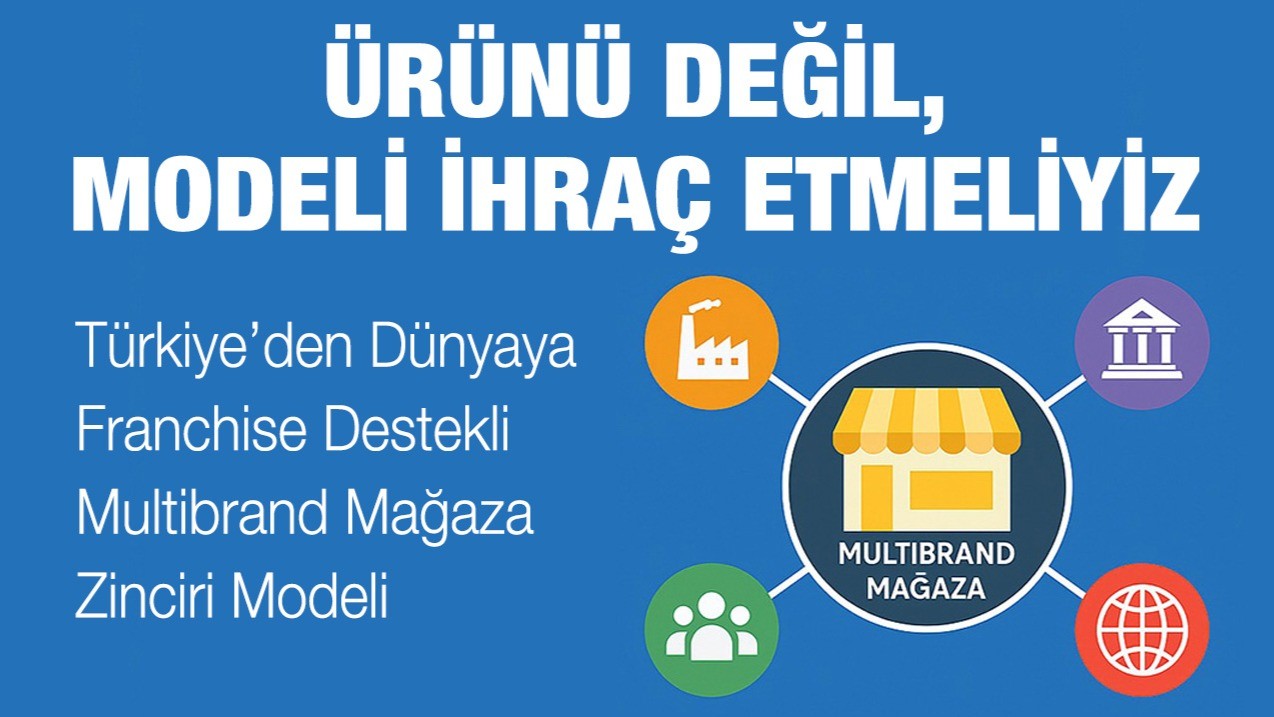
“We Should Export the Model, Not Just the Product!”
When it comes to exports, producing is no longer enough. Selling is no longer enough!
For years we have been repeating the same sentence: “We must make value‑added exports.”
So what happens next?
- The design is ours.
- The R&D is ours.
- The raw material, labor, molds and standards are ours.
But…
- The store belongs to someone else.
- The showcase belongs to someone else.
- The retail margin belongs to someone else.
It is time to ask this question:
“If we produce so much, why can’t we tell the story?”
The Name of the Model: Franchise‑Financed Multibrand Store Chains
This article does not describe an idea. This article describes a model. This model challenges the traditional understanding of exports.
It is not complex. It is realistic. It is applicable. It is sustainable.
In short:
- Many Turkish brands come together under a single roof abroad.
- A chain is formed through franchising with a “multibrand store” concept.
- A foreign investor who purchases the franchise receives financing from a Turkish state bank under suitable conditions.
- Supply, software, training, operations, CRM and digital infrastructure: all provided from Türkiye.
- And the most critical point: manufacturers, suppliers, architects and logistics partners become stakeholders in the system.
The result?
The product sold is ours, the store is ours, and the story is ours.
How Does This Model Work?
1. Who Is the Franchisee?
An investor from abroad. Someone who knows the target market, has a local network, an entrepreneurial spirit and capital.
Perhaps someone from our Turkish diaspora living in that country.
But not like a classic franchise: financial accessibility is provided to enter the system.
2. How Does the Bank Become Involved?
Through overseas branches of Ziraat Bank, Halkbank or Eximbank, credit can be provided to the foreign investor who will purchase the franchise.
This both supports exports and provides regular foreign currency income for the bank.
3. What Does the Partnership Structure Look Like?
A multi‑partner joint‑stock company (A.Ş.) is established to manage the model. This company can be supported by a Venture Capital Investment Fund (VCIF). The Capital Markets Board (SPK) legislation allows this.
Who becomes partners?
- Brands
- Contract manufacturers
- Logistics and architectural offices
- Software and CRM companies
- State banks and/or participating funds
4. Omni‑Channel Is Mandatory
Stores will not only be physical:
- Online shopping infrastructure
- Mobile application
- Loyalty and CRM systems
- Data analytics modules
All will be integrated. Every touchpoint will be fed by data.
Which Sectors Can It Be Applied To?
Ready‑to‑wear + Accessories + Shoes + Bags + Jewelry:
An “Urban Chic” store.
Furniture + Lighting + Decoration:
With concepts such as “Living Turkish” or “Modern Heritage”.
Home textiles + Furniture + Bathrobes + Towels + Beds + Decoration:
A “Home Lifestyle Store”.
DIY Market + Garden + Smart Home Technologies:
A “Practical Living Store”.
Ethnic Products + Gourmet + Cosmetics + Jewelry:
An “Anatolian Concept”.
Kitchenware + Plastic Household Items + Glass and Porcelain:
A “Smart Kitchen Store”.
Coffee + Turkish Delight + Books + Gifts:
A “Cafe Lounge + Culture Store”.
And many more. As long as the target market is matched with Türkiye’s production and branding capabilities.
Why Should Every Store Have Coffee?
Because coffee means experience. Because coffee means conversation.
Today we have local coffee brands that are more creative than global coffee chains. If every multibrand store includes a coffee lounge:
- Customers relax
- The purchasing process becomes longer
- Stories are sold together with coffee
Coffee becomes the insurance of this system.
Why Now?
- Exchange rate increases are putting pressure on export costs
- Global demand is slowing
- Türkiye’s production infrastructure is reaching its limits
A new model is now needed. We must create a difference not with traditional exports, but with system exports.
This is not just a chain store project. It is a new tool of economic diplomacy.
Final Word:
“We should now send systems to the world, not just products.”
“We should build structures that can be operated together, not just things to be sold.”
This model is an ecosystem that will go beyond both traditional trade fairs and traditional export approaches.
Let’s name it together. Let’s grow its vision together.