The saying “location, location, location” still holds true; however, the way we define location itself has changed. In the past, finding the right location was largely about identifying well-known, high-traffic and attractive spots. Today, however, it is far more important to understand which specific spot within the same area is the right fit for a particular brand and investment model. Consequently, we no longer simply ask, ‘Where is the location?’; instead, we ask, ‘Why is this location the right one, and what commercial return will this investment generate here?’ In short, location is still king; but today, it is data that guides the king. Identifying the right location is no longer a matter of a single data point or a single criterion. The key here is not to give equal weight to all this data. This is because the definition of the right location varies from sector to sector, and even from brand to brand within the same sector. For example, whilst nearby attractions and accessibility may be far more decisive for a restaurant, in a different retail category, income levels, household structure or vehicle access may become more critical. Consequently, our approach is not merely to present the data, but to highlight which data is truly meaningful for that investment decision. Here, we must make a point of setting competitor data aside. This is because when you make an investment, you are not merely selecting a location; you are also seeking to secure a share of the commercial pie in that location. If you do not keep a close eye on where your competitors are, how they are positioned and how they move over time, you risk missing out not only on today’s opportunities but also on potential future revenue. We have been regularly updating the data we have collected from the field since 2005. Today, we work with over 5.2 million POI (Points of Interest) data points across more than 470 categories. This data reveals not only direct competitors but also the ancillary sectors and interdependent business sectors that attract customers to that area. Through models and AI-powered algorithms in our software that help interpret the relationships between these parameters, we offer brands the opportunity to analyse their own location scenarios. This is because, in our view, a good location analysis does not end with the question, ‘Where is my competitor?’ The real question is, ‘What kind of commercial ecosystem exists at this location that will bring my customers here and grow my investment?’ Data only delivers its true value when used to answer precisely this question. No, we cannot always say it is a good location. Our experience shows that a good area does not necessarily mean that every spot within it is good. In fact, even in areas with very high commercial footfall or in prestigious shopping centres, we can come across investments that fall short of expectations. The key issue here is identifying the spot within that area that best suits the brand’s customers and business model. This is because even a difference of a few hundred metres along the same street can make a significant difference in terms of visibility, accessibility, the surrounding commercial environment and the customer profile. A difference of just a few hundred metres within the same area can alter visibility, accessibility and the profile of customers in the surrounding area. Segmentation and turnover forecasting tools help the brand to recognise this difference during the decision-making process by analysing location data alongside its own branch data. On-the-ground experience and knowledge of the area are, of course, invaluable. However, they are not sufficient on their own. In my view, one of the most common mistakes brands make is to view the current situation as a guarantee of the future. Assumptions such as ‘This street is doing well’, ‘Our competitor is successful here’ or ‘We know this area very well’ may serve as important reference points to begin with. However, when making an investment decision, it is also necessary to look at how that location has performed in the past. For example, which businesses have opened over the years, which have closed, and which sectors have managed to survive in that area? These questions reveal not only the location’s appeal but also its sustainability. When our historical data, spanning over 15 years, is analysed alongside current location data, it enables brands to see not only the current density of businesses but also how the location has changed over time. We also take this historical context into account in our consumption and turnover forecast scenarios. For an investor, the question is not merely ‘Will this location be profitable?’, but ‘Under what conditions can it be sustainable for my business model?’ Absolutely. In franchise systems in particular, professional site analysis should be a natural part of the investment approval process. There are highly valued professionals in the field who, through years of experience, have developed the ability to understand the local area and the customer base. Today, technology enables us not to replace this experience, but to enhance it with data. In the franchise model, the decisions made affect not only the brand’s future but also that of the investor. For this reason, it is just as important to identify a location with sustainable potential for the investor as it is to select the right location. Thanks to the location data, segmentation models and turnover forecasting tools we provide, the franchisor can compare potential locations against the same criteria. Our AI-powered algorithms can also support this decision by evaluating various parameters together; however, the final investment approval remains the franchisor’s own decision. What sets us apart is our ability to combine technology with reliable and up-to-date data, as well as the franchisor’s own on-the-ground experience. Technically, it is possible, but it would not be accurate to measure this using a single data point. To understand a market’s capacity for branch expansion, it is necessary to assess population, demographics, competition, the existing commercial structure and location performance together. The solutions we offer complement one another in this regard. Whilst the data may answer different questions when examined individually, when assessed together, it reveals where and to what extent a brand can grow. Cannibalisation is just as critical an issue in multi-branch structures as competitor density. Winning customers away from competitors is a measurable benefit; however, when two of your branches share each other’s turnover, this creates a less visible loss. Cannibalisation is also one of the key parameters in our location selection and turnover forecasting algorithms. Consequently, when calculating the potential of a new location, we include not only how much turnover it will generate but also its impact on existing branches in the model. This also provides the brand with an answer not only to the question ‘Where should we open?’, but also to ‘How should we expand our existing network?’. Absolutely. The definition of a ‘good location’ varies from brand to brand. The criteria that matter to a coffee chain cannot be the same as those for a private school, a gym or a car service centre. Our advantage lies in having highly detailed data categorised by sector, a significant portion of which we generate directly from the field. For each sector, we assess not only the competitors but also the supporting sectors that influence customer footfall, evaluating each separately. Consequently, we do not use a single standard location model. We redefine what a location means based on the brand’s business model and target customer. Sector reports, demographic studies and the geographical data we analyse on MapbisBI paint a significant picture for us. High rents, limited supply and high occupancy rates along certain traditional retail corridors in major cities are restricting brands’ scope for growth. The decline in letting volume on Istanbul’s main shopping streets in recent years and the fact that Istiklal Street has reached an occupancy rate of 98 per cent are concrete examples of this pressure. Meanwhile, the spatial structure of cities and lifestyle preferences are also changing. Remote working and post-pandemic mobility have fuelled population movements from major cities towards certain coastal and smaller settlements. For this reason, the challenge for brands is not merely to expand in existing hubs, but to accurately identify new areas of opportunity in terms of population, purchasing power, competition and accessibility. Using MapbisBI to combine various geographical and demographic data, we analyse potential regions that brands can consider for investment on a location-by-location basis. Absolutely. E-commerce has not diminished the importance of physical shops; in fact, it has transformed their role. Today, a shop must be viewed not merely as a point of sale, but as an integral part of customer outreach, delivery and logistics. Consequently, online sales potential, delivery times, order volume and logistics costs have also become key factors in location decisions. Particularly in omnichannel set-ups, the right location must serve both the customer and the operation itself. In other words, alongside the question ‘Where should the shop be?’, we now also need to ask ‘From where can we most efficiently reach the customer and fulfil the order?’. At present, artificial intelligence is not yet an independent decision-making mechanism capable of saying, on its own, ‘open the next 50 branches in these locations’. Artificial intelligence provides particularly strong support when it comes to analysing very large datasets collectively, comparing different scenarios and forecasting future potential; however, manual processes will still be required when dealing with multiple parameters. In the future, location decisions will rely less on intuition and more on foresight. The role of artificial intelligence in this transformation will also continue to grow. The fundamental approach remains the same; however, the data itself needs to be re-examined in the context of that particular country. Road networks, points of interest (POIs), historical mobility patterns, and demographic and socio-economic data remain important. However, consumer behaviour, urban structure and commercial dynamics differ from country to country. For this reason, rather than directly applying the model we use in Turkey to markets such as Germany, Dubai or Riyadh, we need to re-engineer the same approach using that country’s own data. In short, the model may be universal; however, for accurate results, the data must be local and incorporated into the decision-making process within the local culture. The Arabian Peninsula is very hot, making large outdoor presentation areas very challenging, whilst Europe has a society that relies heavily on public transport. These factors make a significant difference to the models. Firstly: Are our target customers actually present at this location, and what does the area’s commercial history tell us? Secondly: How consistent is the customer and sales potential throughout the year? How do seasonality, footfall and existing competition affect this potential? Thirdly: How might transport infrastructure, new investments and demographic or geographical changes in the area affect the future of this location? Because it is not enough for a location to look promising today. What matters is being able to determine, based on data, whether the investment is the right decision not only today but also tomorrow.
One of the oldest sayings in the retail industry is ‘location, location, location’. From an investor’s perspective, does this saying still hold true today, or, given how far data technologies have come, should we now say ‘the right location + the right data’?

For us, it is impossible to separate location from data. Data has become one of the most important tools for understanding location and making more accurate investment decisions. We have been working at the heart of this very transformation since 2005, using the data we have generated from the field.
When a brand decides to open a new shop, restaurant, school, sports centre or service point, what data is currently analysed in combination to identify the right location? How do factors such as population, income levels, age groups, day-time and night-time population, traffic, pedestrian footfall, competitors and nearby attractions all factor into the decision?
Does a high-traffic high street, a prestigious shopping centre or a densely populated area always equate to a good location for brands? Could a location that appears extremely attractive from the outside turn out to be a poor investment for a brand once the data is analysed?

What are the most common mistakes made by growing brands in Turkey when choosing a location? How misleading can assumptions such as ‘This high street is doing well’, ‘Our competitor is successful here’ and ‘We know this area well’ be when compared with the data?
In franchise systems, site selection is not merely a decision to open a new shop, but is also critical to the sustainability of the franchisee’s investment. Do you think professional site analysis should become one of the standard investment approval processes for franchisors?
When a brand tells you, “I want to open 100 new branches in Turkey over the next five years”, can the data tell you not only which towns and districts they should be located in, but also how many branches they could expand to in a given region? How is a market’s capacity for branch expansion calculated?

One of the key risks in the growth of multi-branch brands is cannibalisation; that is, a newly opened outlet taking customers away from an existing branch of the brand rather than from a competitor. To what extent can the optimal branch network and the interactions between branches be modelled in advance using data analytics?
‘Good location’ does not mean the same thing for every brand. How do the location criteria differ for a coffee chain, a restaurant, a private school, a gym, a supermarket, a car service centre or a healthcare facility? Is the location model tailored specifically to the brand and its business model?
The geographical data that Başarsoft has accumulated over the years also provides an opportunity to track Turkey’s economic and sociological transformation. From the perspective of brands’ growth strategies, what changes do you observe regarding the shift in consumption and commercial activity from traditional centres to new regions?

The rise of e-commerce was once interpreted as signalling a decline in the importance of physical shops. Yet today, models such as omnichannel, fast delivery, dark stores and last-mile logistics have taken location decisions to a whole new level. Do brands now have to take online sales and logistics data into account when planning their shop networks?
Where is artificial intelligence taking this sector? In the near future, will it be possible for artificial intelligence to draw up a direct growth map in response to a brand’s question: ‘This is my target customer, this is my shop format, this is the scale of my investment; where should I open my next 50 branches in Turkey?’
How does location analysis change when a Turkish brand decides to expand internationally? For example, for a brand wishing to expand into Germany, Dubai or Riyadh, to what extent can the models you use in Turkey be applied; what new data sets are required?

Finally, if we were to ask you to give just one piece of advice to a brand owner or franchise manager: what are the three questions that brand management must know the answers to before a lease agreement for a new branch is signed and the franchisee is asked to make an investment?
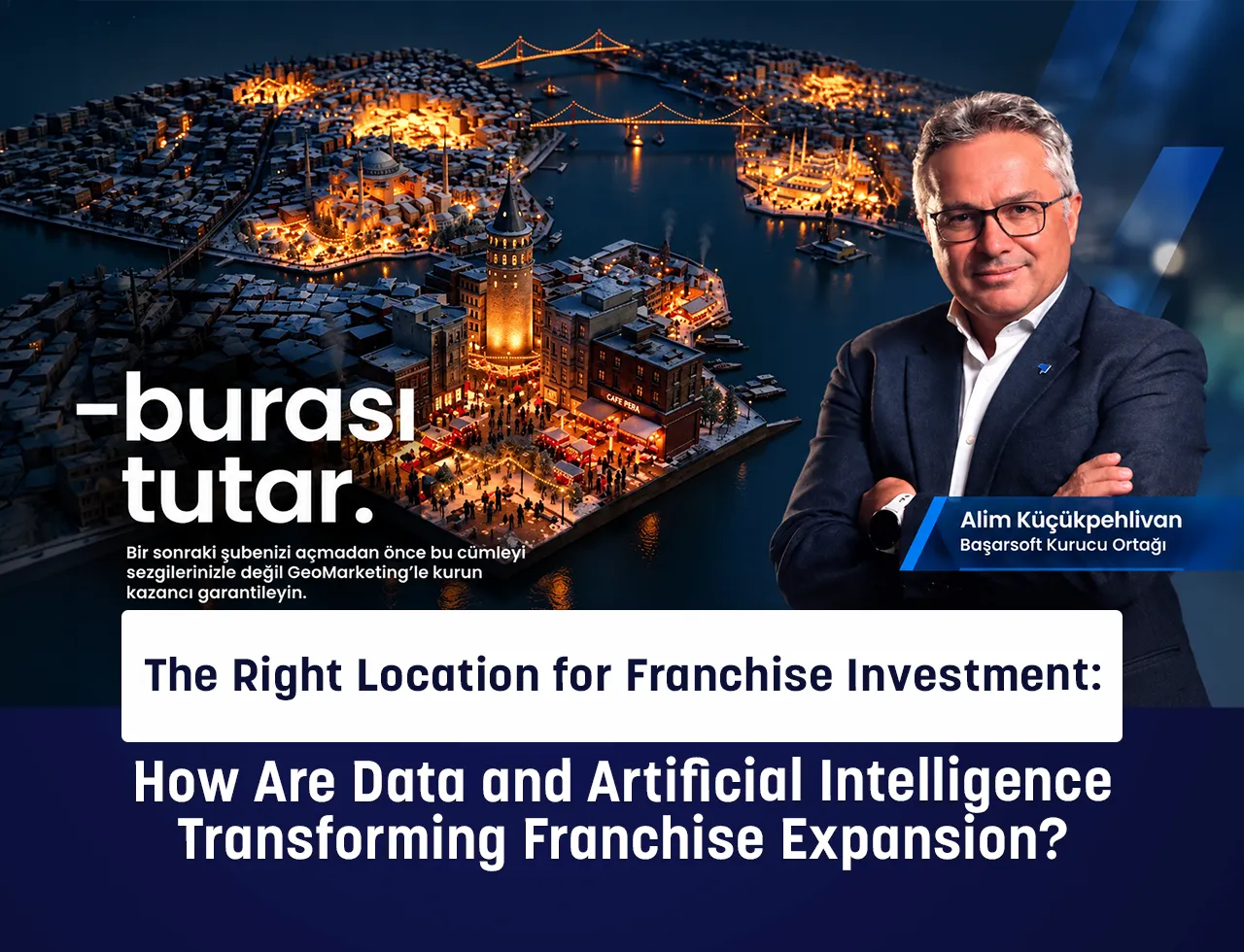
The Right Location for a Franchise Investment: How Data and Artificial Intelligence Are Transforming Franchise Expansion?
Alim Küçükpehlivan, Co-Founder of Başarsoft, says that location selection for franchise brands can no longer be based solely on busy streets, population, or intuition. With over 5.2 million location data points, revenue forecasting models, and AI-powered analytics, decision-making processes regarding where brands should expand, how many branches they should open, and which growth model to adopt are being reshaped.