 In recent years, global economic shifts have begun to clearly reveal where the next growth frontiers are emerging. While expansion in many mature markets is slowing down, the African continent is demonstrating remarkable dynamism driven by its young population, rapidly expanding cities, and growing consumer demand.
Today, Africa is no longer attracting attention solely for its natural resources. Retail, services, financial technologies, and entrepreneurial ecosystems are increasingly positioning the continent as a key destination on the global investment map. In this context, the franchise model has become one of the most effective bridges connecting international brands with local entrepreneurs and investors
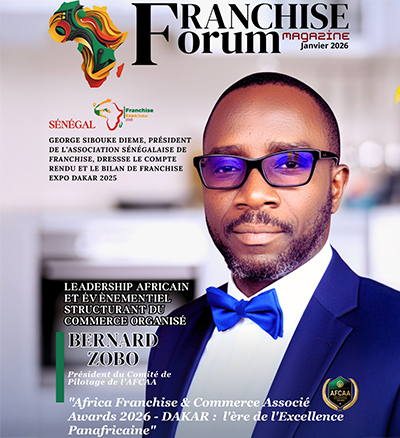 To better understand the evolution of the franchise ecosystem across the African continent, we conducted an in-depth interview with Naki Bernard Zobo, Director of Africa Franchise Forum Magazine, one of the leading media platforms dedicated to franchise development in Africa.
According to Zobo, franchising in Africa is not merely a business model; it is increasingly becoming a strategic tool for economic development, entrepreneurship, and job creation. The continent is no longer simply waiting for investment opportunities. It is developing a more informed investor base and an evolving business ecosystem capable of making its own strategic choices.
In this interview, we explore the development of franchising across Africa, the profile of emerging investors, gateway markets for international brands, and the opportunities that may shape the next decade of growth.
Because today, perhaps the most accurate way to describe Africa’s position is this:
Africa is not waiting. It is choosing.
For readers who may not yet be familiar with Africa Franchise Forum Magazine, could you briefly introduce your publication and the mission that motivated its creation?
Africa Franchise Forum Magazine was born from a simple but striking observation: Africa is full of serious investors, dynamic markets, and growing demand for proven franchise concepts, yet there was no pan-African platform dedicated to connecting these ecosystems and fostering harmonized structuring across an evolving and fragmented ecosystem.
Our mission is twofold.
On one hand, to educate and inform: we aim to demystify franchising for African investors and entrepreneurs who often perceive it as a domain reserved for wealthy corporations and multinationals, when in fact there is real potential within their ranks to bring forth national champions.
On the other hand, to facilitate connections between ambitious global brands and local capital holders seeking proven, transferable, and profitable business models.
The goal is to help them operate in a structurally harmonized environment aligned with international standards, yet adapted to African realities.
We serve as a trusted bridge between two worlds that have long been seeking each other.
Africa Franchise Forum is more than a magazine — it is an ecosystem: events, investor database, operational consulting, and direct matchmaking.
Through its website and publications in print-on-demand or digital format, Africa Franchise Forum Magazine offers:
- In-depth analyses of market trends and methodologies for creating, managing, and developing franchises, as well as regional regulations and the structuring of franchising and organized retail trade.
- Academic and expert research articles on franchising and organized retail trade in Africa and worldwide.
- Profiles of successful entrepreneurs and franchises.
- Practical advice for launching or developing a franchise as a franchisor or franchisee.
- Regional focus pieces on African markets with promising ecosystems.
- Expert interviews and feedback from experience.
- Promotions and coverage of all franchise and organized trade events in Africa and worldwide.
What are the main sectors currently experiencing the fastest franchise growth on the continent?
This analysis is based on data from our special edition “Top 50 Franchisors and Associated Retailers in Africa,” published in August 2025.
African franchising has entered a phase of structural acceleration.
Our ranking covers 13 active sectors on the continent, but some stand out clearly for their dynamism. Here is the sector-by-sector breakdown supported by data.
1. Technology, Digital & Financial Services – the Rocket Sector
This is unquestionably the most explosive sector. Urban mobility platforms record an average CAGR of 35%, express logistics solutions achieve 40% annual growth, and digital micro-credit services show 28% per year.
Mobile financial agent networks, operating on a micro-franchise model, have accumulated more than 300,000 active service points across the continent, processing billions of transactions annually.
With more than 600 million Internet users in Africa in 2024 and one of the fastest digital adoption rates in the world, this sector is no longer emerging — it is dominant.
2. Vocational Training & Education – Demographics as the Engine
With more than 60% of the African population under 25 years of age, education and training represent a structural, non-cyclical need.
Digital vocational training platforms have recorded a CAGR of 35% since 2021, driven by demand for digital skills, management, and entrepreneurship.
Educational micro-franchise models, accessible from $10,000 initial investment, attract teachers, parents, and entrepreneurs.
More than 500,000 active learners are already counted on hybrid platforms alone, operating in more than 10 African countries.
3. Solar Energy & Sustainable Development – Urgency Creates the Market
More than 600 million Africans still lack access to electricity. This massive deficit generates irrepressible demand.
Residential solar energy distribution franchises show a CAGR of 35% since 2018, with certified agents operating as micro-franchisees for an initial investment of $5,000 to $15,000.
French-speaking players in West Africa record annual growth of around 30%, driven by turnkey models across 8 countries.
In 2024, some solar networks announced having avoided more than one million tons of CO₂ through their deployment.
4. Health & Community Care – Access to Healthcare
The franchised healthcare sector is experiencing a remarkable rise. Primary care clinic networks display a CAGR of 15% over five years, with more than 200 centers operational in sub-Saharan Africa.
Community health micro-franchises record 25% annual growth since their launch.
5. Fast Food & Food Service – the Historic Locomotive Sector
Foodservice remains the most visible and mature sector. Some networks exceed 350 units in 12 countries and the continental leader has more than 1,000 points of sale in over 20 African countries.
6. Urban Agriculture, Agribusiness & Food Logistics – the Next Frontier
Africa holds 60% of the world's uncultivated arable land while still massively importing its food commodities. This paradox creates a tremendous opportunity for agri-food franchises and agricultural distribution platforms.
Digital agricultural supply chain solutions show growth of 40–45% per year.
Modern beekeeping franchises, local agri-food processing, and solar cold chains record CAGRs between 25% and 30%.
The sectors with the fastest growth in African franchising are those addressing structural deficits: energy, healthcare, education, and financial services.
These are not comfort markets — they are necessity markets. And necessity markets, with the right franchise model, do not experience recessions.
Fast food remains the dominant sector by volume, but it is no longer alone at the top. Africa is franchising its fundamental needs — and that is where the most enduring opportunities lie.
Which African countries currently offer the most interesting opportunities for international franchise brands?
Drawing on our aforementioned special edition, we can say the following:
1. South Africa — The Essential Hub
It is the most mature market and the natural entry point for any international brand. It is the only African country where all analyzed sectors are simultaneously represented — foodservice, retail, healthcare, education, services, technology, and energy.
Networks here have their largest concentrations of points of sale: more than 800 units for some health-beauty distribution players, more than 3,000 stores for major food retail groups, and more than 300 pharmacies for integrated care networks.
South Africa also has a structured and active national franchise federation, a clear legal framework, and a strong entrepreneurial culture favorable to franchise models. The franchise contract renewal rate exceeds 90%.
It is the market where brands test, validate, and structure their model before expanding across the rest of the continent.
2. Kenya — The Gateway to East Africa
Kenya appears in almost all sectors of our ranking including foodservice, retail, education, healthcare, technology, logistics, agriculture, tourism, and energy.
It is one of the most diversified and open markets in East Africa. Nairobi has become a regional franchise capital supported by strong digital, banking, and commercial infrastructure.
3. Nigeria — Raw Demographic Power
With the largest population on the continent, Nigeria is impossible to ignore for international brands with pan-African ambitions.
Lagos and Abuja host a strong urban middle class eager for new concepts. Although the market can be complex due to logistics and regulation, successful players benefit from unmatched scale across Africa.
4. Morocco — North African Platform
Morocco has advanced legal and organizational structures around franchising. It also functions as a financial and logistics hub connecting Europe and sub-Saharan Africa.
Many international brands use Morocco as a strategic base for expansion toward French-speaking African markets.
5. Senegal & Côte d'Ivoire — The Locomotives of Francophone Africa
These markets appear in our ranking across sectors such as foodservice, retail, healthcare, education, technology, solar energy, agriculture, and tourism.
Both countries operate within the OHADA legal framework, which harmonizes commercial law across 17 African countries — a major strategic advantage for franchise expansion.
6. Ghana — Stability as a Competitive Advantage
Ghana stands out due to its political and macroeconomic stability. Many franchisors choose Ghana as a learning market before expanding into larger markets like Nigeria.
7. Rwanda — Small Market, Big Ambitions
Despite its modest size, Rwanda offers one of the most favorable administrative environments for business creation in Africa. Kigali has become a showcase for economic governance and attracts regional headquarters of international companies and investment funds.
How would you describe the typical profile of an African franchise investor?
The African franchise investor is more sophisticated than commonly believed.
They often have business experience, a solid network, and sharp commercial acuity.
What they are looking for is the combination: a proven concept, genuine support, and transparent return on investment.
Contrary to common misconceptions, African investors are well informed about international trends.
Interested franchisors should therefore meet the standards required for international franchising and apply the same strict recruitment criteria they use in their home markets.
The master franchisee is generally a seasoned entrepreneur, often a family group or fund aiming for territorial dominance.
The single-unit investor tends to be younger, often a senior executive or professional looking to diversify their income or launch their first business. In both cases, financial transparency is non-negotiable.
When an international brand enters an African market, what local advisors facilitate franchise operations?
The support ecosystem exists but is still fragmented.
My first recommendation: never enter an African market without local legal counsel specific to the target country.
In the OHADA zone the legal framework is unified and favorable to investment.
Beyond the legal dimension, the true accelerators are local franchise consultants, national franchise associations, and platforms like ours.
The local partner is not optional — it is a determining success factor.
Another very important factor is adaptation to African customs and local realities.
What are the most common challenges for foreign brands entering Africa?
Most failures do not come from the African market but from the brand itself.
First mistake: believing that a concept working in Europe or the United States will work identically in Africa.
Africa is a continent of 54 nations with radically different cultures and consumption habits.
Second challenge: logistics and supply chains. Brands that succeed anticipate this and work early on local sourcing.
Third challenge: underestimating timelines. Africa has its own administrative rhythm. Strategic patience is a competency.
Fourth challenge: the digital divide. Systems must operate in both digital and manual modes.
Fifth challenge: ignoring the informal economy. The best performing networks integrate local producers and independent agents into their supply chains.
Streets or shopping malls?
Shopping malls are ideal for first establishments because they provide infrastructure, visibility and security.
However commercial streets offer higher traffic and lower rent.
Strategic recommendation:
Start in malls to build brand awareness, then expand to commercial streets for profitability.
Which franchise concepts attract the most interest?
As discussed earlier, sectors solving structural deficits attract the most attention:
- Energy
- Healthcare
- Education
- Financial services
Food service remains the most visible sector.
Importance of international franchise exhibitions?
Trade shows are irreplaceable.
Franchising is a trust business.
Events like Franchise Expo Paris and others accelerate deals that would otherwise take months.
However, events in Africa must also offer training, financing opportunities, and ecosystem support.
How can Turkish brands succeed in Africa?
Turkish brands have an excellent price-to-quality positioning.
Turkey also benefits from a strong positive image on the continent.
My recommendation:
- Adapt concepts to local realities
- Choose the right linguistic markets
- Work with strong local partners
What role can Bayim Olur musun play?
Bayim Olur musun is a powerful tool.
It exposes franchise concepts to serious investors and accelerates connections.
Such platforms can:
- Showcase Turkish brands
- Pre-qualify African investors
- Build credibility for brands entering the continent
Africa Franchise Forum is ready to act as the African partner for such initiatives.
Final message to Turkish brands
Africa is not waiting — it is choosing.
The best markets, locations and franchisees will be taken by brands that move early.
My message is clear:
Come with humility, listen to the market, adapt your model, and invest in long-term relationships.
Africa rewards partners, not predators.
Naki Bernard Zobo
Director — Africa Franchise Forum Magazine
Email: [email protected]
Website: afranchiseforum-mag.com