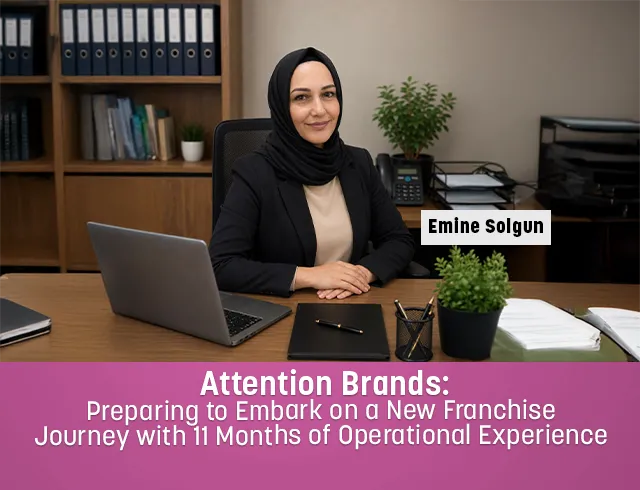
THE STORY BEHIND THE INTERVIEW:
I met Emine Hanım briefly at the Coffex Fair, where I was attending as a guest of Zeynep Gözdoğan, Editor-in-Chief of Franchise Market Magazine. When I learned that she is a senior executive at a franchisee organization operating 11 branches under the Tavuk Dünyası brand, our conversation became even more meaningful to me.
This is because for months now, in my articles both in Para Magazine and on social media platforms, I have been explaining under the heading “The Big Game in Franchising” that investors should now evaluate an approach focused on building platforms rather than individual businesses. Examples around the world are growing and scaling up; as large capital in Turkey shifts from its traditional comfort zone centered on foreign exchange, interest rates, and the stock market toward the real sector, I believe franchise platforms will grow rapidly.
That’s why learning that Emine Hanım manages an 11-branch franchise operation across all its layers felt like the real-world counterpart to the transformation we’ve been discussing in theory. To delve deeper into the conversation, we headed to the Kurukahveci Mehmet Efendi Lounge with her and the friends who introduced us.
There, Emine Hanım explained that they could now combine their existing operational experience with the right brand in the coffee sector. The goal is not merely to make a new investment; it is to establish a long-term, manageable growth model while increasing the sectoral diversity in their portfolio.
We agreed to conduct this interview with her—one that, in my view, is a strong contender for one of the most compelling interviews of the year.
I actively manage the field, team, operations, and process management aspects of a franchise operation comprising approximately 11 branches. Our operations are located in the Marmaris, Aydın, İzmir, Kütahya, Nazilli, Denizli, Uşak, Salihli, and Ankara regions. We work with a team of approximately 150 people. Today, we’re not just managing restaurants. We’re simultaneously handling people management, crisis management, operational standards, investor relations, and the organization of sustainable growth. In a single day, we might be discussing staff scheduling for one branch while also handling an investment process, cost analysis, a shopping mall meeting, or the team structure for a new branch opening in another city. The most important thing is not to lose operational discipline as we grow. Sustainability in the restaurant industry is only possible with structures that truly stay on top of the field. “A single branch can be managed on instinct. A multi-branch structure requires a system.” In my opinion, the most critical issue is establishing a system. Because once you reach a certain point, you need to manage the business not through individual instincts, but with the right operational infrastructure. Many shortcomings can go unnoticed in a single branch; however, as the number of branches increases, unstructured operations quickly begin to spiral out of control. For me, the most critical areas are proper team structure, field oversight, rapid communication, cost and inventory management, continuous training, and maintaining the same operational standards across all branches. I don’t place much faith in operations managed solely from a desk. When you don’t engage with the field, problems only become visible after they’ve grown. What approach sets you apart from other managers in operations management? I believe the most important thing that sets me apart is my ability to focus not only on the numerical aspects of operations, but also on the human and on-site aspects at the same time. In restaurant operations, you cannot build a sustainable structure by looking solely at revenue or solely at costs. Team motivation, on-site discipline, guest experience, crisis response, and operational standards must all be managed simultaneously. I strive to manage operations not by monitoring them remotely, but by being fully immersed in the field. Throughout the day, I might go from staff scheduling at one branch to a business meeting in another city, while simultaneously handling cost control or opening preparations. This pace ensures you don’t lose touch with the operation’s true dynamics. Another key approach of mine is designing processes not just to get by today, but to support growth. Because in the restaurant industry, structures that accelerate without establishing systems can eventually struggle. One of the key things that sets me apart from other managers is that I truly love what I do. Success is one of the things that drives me the most. I don’t do a job just for the sake of getting it done. I approach processes with great care because I know that details that may seem minor on the operational side can lead to significant outcomes. A staff issue, guest experience, cost detail, or operational glitch on the floor isn’t just a daily matter for me; it serves as data reflecting the overall health of the system. I believe it’s essential to see not just the reporting side of operations, but its real-world impact on the ground. Because success in restaurant operations is built on discipline, follow-through, speed, and attention to detail. “Operations management isn’t just about managing; it’s about developing the system and instilling that motivation in the team.” I’ve been involved in restaurant operations for years. This experience has given me the opportunity to closely observe consumer behavior, operational discipline, and brand management. The main reason for my interest in the coffee industry is that this sector offers not just product sales, but also a serious lifestyle and experience management. People no longer choose these brands just to drink coffee; they also choose them to socialize, work, spend time, and feel good. Another notable aspect is that the industry has a scalable and sustainable structure when managed correctly. However, what excites us here is not merely making a new branch investment; it’s the potential to build a larger structure by combining our operational experience with the right brand and the right system. Thanks to the field experience we’ve gained over the years within franchise systems, we can now see more clearly what works, what mistakes slow down brands, and what kind of system is needed for sustainable growth. For this reason, I view the coffee sector not merely as a new investment area, but as a strategic field we’re evaluating for the long term. When evaluating a coffee brand, the first thing I look at is whether the brand has a truly sustainable system. Today, many brands aim for rapid growth; however, when the operational infrastructure doesn’t develop at the same pace, control issues can arise after a while. Second, I look at operational discipline and the franchise management structure. Is the brand merely a structure that sells products, or is it a system that guides, supports, and grows alongside its franchisees? This is very important to me. Training processes, field support, operational standards, and crisis management are the factors that determine long-term success. Third, I look at the brand’s vision. Because I see a significant difference between brands that merely want to increase the number of branches and those that aim for controlled and healthy growth. “We’re not looking for a new sign; we’re looking for a system we can grow with.” When evaluating a coffee brand, the first thing I look at is its operational system and sustainability. This is because, in the restaurant and franchise sector, managing that growth effectively is just as important as growing. Second, I examine the relationship between the brand and its franchisees. Whether the brand views its franchisees merely as investors opening branches or as business partners with whom it grows together is a key criterion for me. Third, I pay close attention to the brand’s vision and future growth plans. Brands that focus solely on rapid growth can eventually face operational challenges. Structures that grow in a controlled, systematic manner while preserving brand value inspire greater confidence in me. Today, thanks to the experience we’ve gained over the years on the operational side, we can clearly see that the right system, the right franchisee, and the right brand culture determine a brand’s fate. From an operations manager’s perspective, a lack of communication is one of the main issues that could cause me to walk away from a brand the fastest. The franchise system isn’t just a structure that runs on a contract; it’s a system that thrives on strong communication and mutual trust. I believe it’s a major problem to view a business partner solely as an investor and leave them on their own during operational processes. Organizations that fail to genuinely listen to on-the-ground issues, generate solutions, or establish proper support mechanisms may eventually struggle. Another red flag for me is a lack of operational support. In brands where training processes, field support, crisis management, and operational standards are weak, the system can eventually fall apart over time. “The franchise system grows not through contracts, but through trust and communication.” For a brand to give me this feeling, it must first view its business partners not merely as investors, but as true partners with whom it walks side by side. Just as a brand sets goals for its own success, growth, and sustainability, it should strive for the same vision for its business partners. Especially given Turkey’s economic realities, business doesn’t always move at the same pace. During good times, everyone can manage the process with ease. But what matters is the brand’s approach during challenging times. In periods of rising cost pressures and operational difficulties, a solution-oriented approach, support, and shared reflexes are crucial to me. Because I believe that true franchise success isn’t just about opening branches, but about walking together strongly for many years to come. I’m not just talking about an entity that makes financial investments. We’ve been right in the thick of operations for years. From opening processes to team management, from cost control to crisis management, and from training systems to investment planning, we’ve gained firsthand experience across many layers of the franchise structure. That’s why we no longer view a brand through the lens of simply “opening a branch.” I believe we possess the experience to contribute in areas such as the right location selection, team structure, operational standards, franchisee management, and a sustainable growth model during the brand’s growth process. For me, it’s not just about increasing the number of branches; it’s about establishing the right system and building a strong, long-term structure. That’s why we position ourselves not merely as investors, but as long-term business partners who contribute to the brand’s operational growth. Our approach to the coffee sector isn’t limited to making a few targeted investments. If the right partnership structure and brand model are established, it may be possible to transform this into a larger and more sustainable structure. For us, the most important factor here is controlled growth. This is because we see very clearly in the field that systems that grow rapidly without first establishing an operational infrastructure eventually struggle. For this reason, we first want to thoroughly analyze the brand, the system, the operational structure, and the mutual business model. If a structure emerges that shares the same vision, thinks long-term, and has a culture of growing together, we can plan for a larger franchise structure starting with regional development. Given our current operational experience, team management, and multi-location expertise, I believe we have the infrastructure to manage such a structure. In my opinion, the coffee market in Turkey still has growth potential. However, it is no longer as easy to achieve rapid success simply by launching a coffee brand, as it was in the industry’s early days. The market has grown, consumption habits have changed, and coffee has become an integral part of daily life. This keeps the sector an attractive investment opportunity. In this new era, the bulk of the business now revolves around the right location, the right brand, and effective operational management. This is because today’s consumers pay attention not only to the product but also to the experience, service standards, and brand culture. Therefore, what matters now is not just having a presence in the coffee sector but establishing the right system and managing it sustainably. In my opinion, the biggest mistake being made in the coffee industry today is that some investments are being made based on hasty decisions. With the industry’s growth in recent years and the rise in popularity of coffee brands, many investors have turned to this sector. However, some investments were evaluated solely through the lens of a “trendy industry.” The coffee industry may seem more comfortable from the outside. In reality, it requires serious operational discipline, cost control, location analysis, and brand management. It becomes sustainable not just through capital, but through the right systems, the right team, and the right operational culture. You need to have a firm grasp not only on the investment side but also on the operational side. “Being a trend is one thing; building a sustainable system is another.” Whatever success story, growth goal, or brand journey you’ve planned for yourself, I work with the same vision for my own operations and company. My goal isn’t just to open branches or make investments; it’s to build strong, long-term structures with the right business partners. Thanks to our years of experience in the field, we have a clearer understanding of what works in franchise systems, what drives brand growth, and which mistakes slow the system down. That’s why what matters most to me isn’t just commercial profit; it’s building structures that grow together, support one another, and think long-term. We are not just an investment firm; we are a team that has grown within the business, knows the field, and lives the system. At this stage, our goal is no longer just to open branches, but to build long-term success stories together. When we partner with the right brand, I believe our operational strength, field experience, and accumulated knowledge within franchise systems will yield strong results. Our goal is not short-term growth; it is to build sustainable structures that will endure for many years with the right systems, the right teams, and the right brands. For this reason, we are open to discussions with brands that share the same vision and believe in growing and developing together.
First of all, could you tell us a little about yourself and the organization you lead today? How many people are in your team, how many locations do you have, and what kind of daily operations do you manage?
Managing an operation with 11 branches simultaneously requires significant field experience. In your opinion, what are the most critical success factors in multi-branch management?
What sets your approach to operations management apart from that of other managers?
What was it like to work within fast-paced operational environments as a female executive? Were there any aspects that gave you an advantage?
You’ve been in the restaurant business for years. Despite that, what is the main reason you’re interested in the coffee industry today?
When it comes to coffee, what excites you—the product, the concept, customer behavior, or the potential for scalability?
What are the first three criteria you would consider when evaluating a coffee brand?
When you look at things not from an investor’s perspective but from an operations manager’s perspective, what are the red lines that could cause you to distance yourself from a brand?
Today, many brands are talking about franchise growth. However, companies like yours, with strong operational structures, are being more selective. What does a brand need to offer to give you the sense that “we can grow together”?
You said you want to be not just an investor, but an operational growth partner. What exactly do you mean by that?
When it comes to coffee, is your goal a few targeted investments, regional development, or a larger-scale expansion?
Do you think the coffee market in Turkey still has room to grow, or has the focus in this new era shifted more toward choosing the right location and the right brand?
You’ve been in the field for years. In your opinion, what is the biggest mistake being made in the coffee industry today?
If the founder of a coffee brand were reading this interview today, what would you say to them?
Finally, would you like to share a brief message with the brands you’re currently open to working with?
Apply Now to Get in Touch
Clarification Text
This Clarification Text has been prepared by EREM YAYINCILIK TANITIM HİZ. LTD. ŞTİ. (“Bayim Olur musun”, the “Company” or the “Portal”) in its capacity as data controller pursuant to the Law No. 6698 on the Protection of Personal Data (“KVKK”).
This text aims to inform you about the purposes for which personal data collected through the www.bayimolurmusun.com.tr website/portal is processed, to whom it may be transferred, by which methods it is collected, and the rights of personal data owners under KVKK.
1. Identity of the Data Controller
Your personal data may be processed by EREM YAYINCILIK TANITIM HİZ. LTD. ŞTİ., acting as the data controller, in accordance with KVKK and the relevant legislation.
2. Purposes of Processing Personal Data
Your collected personal data may be processed in accordance with the fundamental principles set out under KVKK for the following purposes:
- Conducting portal membership processes
- Conducting user, investor, entrepreneur, and corporate member registration processes
- Operating the processes for enabling users to benefit from the products and services offered through the portal
- Conducting application processes regarding franchise, dealership, business partnership, and investment opportunities
- Enabling communication between applicant investors/entrepreneurs and relevant brands/franchise providers
- Conducting corporate membership, brand panel, and application management processes
- Responding to user requests, complaints, and support processes
- Improving and customizing products and services according to user needs
- Planning and carrying out commercial activities
- Conducting promotional, informational, campaign, event, and marketing activities
- Conducting customer satisfaction, survey, analysis, and market research activities
- Ensuring the security of the portal and preventing misuse
- Ensuring legal, technical, and commercial business security
- Fulfilling legal obligations
- Fulfilling information-sharing obligations towards authorized public institutions and organizations
3. Personal Data Processed
The following personal data may be processed within the scope of portal use and membership processes:
- Name and surname
- E-mail address
- Phone number
- Company/brand information
- Title and position information
- Application and request information
- Investment preference information such as investment budget, investment location, and sector of interest
- IP address
- Device, browser, and session information
- Transaction security records
- User activity and portal usage information
- Communication permissions and consent records
- Request, complaint, and support correspondence
4. Parties to Whom Personal Data Is Transferred and Purposes of Transfer
Your personal data may be shared with the following parties, limited to the purposes stated above and in accordance with Articles 8 and 9 of KVKK:
- Relevant brands/franchise providers to which applications are submitted
- Business partners
- Suppliers
- Software, hosting, server, SMS, e-mail, and technical infrastructure service providers
- Third parties from whom advertising, marketing, and analytics services are received
- Legal and financial advisors
- Authorized public institutions and organizations
- Legally authorized private institutions and organizations
If you apply for a brand or franchise opportunity through the portal, your name, surname, phone number, e-mail address, investment preferences, and application information may be shared with the relevant brand/franchise provider for the purpose of evaluating your application and contacting you.
5. Method and Legal Grounds for Collecting Personal Data
Your personal data may be collected through the website, membership forms, application forms, contact forms, cookies, call center, e-mail, SMS, phone, social media channels, and similar physical or electronic environments.
Your personal data may be processed based on the following legal grounds specified under Articles 5 and 6 of KVKK:
- Your explicit consent
- Being directly related to the establishment or performance of a contract
- Fulfillment of legal obligations
- Necessity of data processing for the establishment, exercise, or protection of a right
- Necessity of data processing for our legitimate interests
- Being expressly provided for by law
6. Your Rights Under Article 11 of KVKK
As a personal data owner, you have the following rights under Article 11 of KVKK:
- To learn whether your personal data is being processed
- To request information if your personal data has been processed
- To learn the purpose of processing your personal data and whether it is being used in accordance with that purpose
- To know the third parties to whom your personal data has been transferred, whether domestically or abroad
- To request correction if your personal data has been processed incompletely or inaccurately
- To request the deletion or destruction of your personal data
- To request that correction, deletion, or destruction operations be notified to third parties to whom your personal data has been transferred
- To object to any result against you arising from the analysis of processed data exclusively through automated systems
- To request compensation if you suffer damage due to the unlawful processing of your personal data
You may submit your requests within this scope to the Company via [email protected].
Your applications will be concluded as soon as possible and within no later than 30 days, depending on the nature of your request.
Membership Agreement
1. Parties
This Membership Agreement (“Agreement”) has been concluded electronically between EREM YAYINCILIK TANITIM HİZ. LTD. ŞTİ., located at Dap Vadisi, Merkez Mahallesi, Kağıthane Caddesi No:5, Kat:3 İç Kapı No:96-97, Y Ofis, 34406 Kağıthane, İstanbul/Türkiye (“Bayim Olur musun” or the “Company”), and the real or legal person user who becomes a member of the website/portal www.bayimolurmusun.com.tr (“Member”, “Corporate Member” or “User”).
By registering on the Portal or using the Portal services, the User is deemed to have accepted this Agreement, the terms of use published on the Portal, the KVKK Clarification Text, the Explicit Consent Text, the Commercial Electronic Communication Information Text, and other relevant policies and rules.
2. Definitions
Portal: Refers to the website consisting of the domain name www.bayimolurmusun.com.tr and its subdomains, which brings together investor/entrepreneur users and corporate members offering franchise, dealership, and business partnership opportunities.
User: Refers to any real or legal person accessing the Portal.
Member: Refers to the user who becomes a member of the Portal and benefits from the services offered within the Portal.
Corporate Member: Refers to a real or legal person user who is a member of the Portal, engages in commercial activities, and shares brand/franchise/dealership/business partnership information through the Portal.
Investor Member: Refers to a real or legal person user who reviews franchise, dealership, or business partnership opportunities through the Portal, submits applications, or wishes to contact brands.
Store / Brand Panel: Refers to the private management area where the Corporate Member can add, edit, display, and manage brand, franchise, or dealership information and view and manage applications on the Portal.
Sub-User: Refers to the real person authorized by the Corporate Member to perform transactions on the Portal on behalf of the Corporate Member.
Content: Refers to all kinds of information, text, visuals, videos, logos, brand information, franchise terms, investment information, documents, and similar content published on the Portal.
Personal Data: Refers to any information relating to an identified or identifiable real person within the scope of KVKK.
3. Subject and Scope of the Agreement
The subject of this Agreement is to determine the terms of use of the services offered on the Portal, membership conditions, and the rights and obligations of the parties.
The User agrees to act in accordance with this Agreement, applicable legislation, general moral rules, the principles of good faith, and all policies and statements published on the Portal while using the Portal.
4. Membership Conditions
A user who wishes to become a member of the Portal is obliged to provide the information requested in the membership form accurately, completely, and up to date.
Bayim Olur musun reserves the right to reject any application, request additional information and documents, suspend membership, or terminate membership.
Users who wish to register as Corporate Members must be authorized to conduct commercial activities and, if acting on behalf of a legal entity, must be authorized to represent and bind the relevant legal entity.
Membership rights are personal or institution-specific. Membership cannot be transferred to third parties without the written approval of Bayim Olur musun.
5. Corporate Membership and Brand Panel
The Corporate Member may use the brand panel provided to them in order to publish brand, franchise, dealership, or business partnership information on the Portal and manage applications.
The Corporate Member accepts that all information published on the Portal is accurate, up to date, complete, and compliant with applicable legislation.
The Corporate Member is solely responsible for all information such as investment amount, franchise entry fee, contract terms, dealership conditions, location information, brand descriptions, and similar details.
Bayim Olur musun is not obliged to investigate the accuracy of the information provided by the Corporate Member.
6. Sub-Users
The Corporate Member may define sub-users to use the brand panel.
The Corporate Member is responsible for all transactions and actions carried out by Sub-Users on the Portal.
The Corporate Member is obliged to remove Sub-Users whose authorization they wish to revoke through the system without delay or notify Bayim Olur musun accordingly.
7. Rights and Obligations of the Member
The Member accepts, declares, and undertakes that they shall:
- Act in accordance with all rules on the Portal and applicable legislation,
- Ensure that the information provided within the scope of membership is accurate and up to date,
- Be responsible for the security of their username and password,
- Not process, share, or use personal data belonging to others unlawfully,
- Not perform any actions that may endanger the security, operation, or infrastructure of the Portal,
- Not copy, reproduce, distribute, or publish the content on the Portal on other platforms without permission,
- Not infringe the intellectual property rights of Bayim Olur musun,
- Not share content that is unlawful, misleading, deceptive, incomplete, or that violates the rights of third parties.
8. Rights and Obligations of Bayim Olur musun
Bayim Olur musun aims to provide the necessary technical infrastructure to make the services offered through the Portal available to a reasonable extent.
However, Bayim Olur musun does not guarantee that the Portal will be uninterrupted, error-free, or continuously accessible.
Bayim Olur musun may:
- Make changes to Portal services,
- Suspend or terminate memberships,
- Remove content that is contrary to law, morality, protection of personal data, third-party rights, or Portal rules,
- Request information, documents, or corrections from the Corporate Member where deemed necessary,
- Publish advertising and promotional spaces on the Portal,
- Share information with authorized institutions and organizations within the scope of legal obligations.
9. Application and Information Sharing
If an Investor Member applies for a brand, franchise, or dealership opportunity through the Portal, their name and surname, phone number, e-mail address, investment preference, and application information may be shared with the relevant Corporate Member/brand.
This sharing is carried out for the purpose of evaluating the application and enabling the relevant brand to contact the investor.
The Corporate Member accepts that they shall use the personal data provided to them only for application evaluation and communication purposes, shall not process such data unlawfully, shall not share it with third parties, and shall comply with their obligations under KVKK.
All administrative, legal, and criminal liability that may arise due to the Corporate Member unlawfully processing, sharing, or using personal data shall belong to the Corporate Member.
10. Accuracy of Content and Liability
All content on the Portal, including brand, franchise, dealership, investment amount, entry fee, contract terms, location information, and similar information, is provided by the relevant Corporate Member/brand.
The accuracy, completeness, currency, and compliance with legislation of such information are entirely the responsibility of the relevant Corporate Member/brand.
Bayim Olur musun does not accept responsibility for information provided by Corporate Members that may be incorrect, incomplete, outdated, or contrary to applicable legislation.
Before making an investment decision, the Investor Member should contact the relevant brand/franchise provider directly, carefully review all terms and conditions, and obtain the necessary legal, financial, and commercial advice.
11. Privacy and Protection of Personal Data
Bayim Olur musun processes personal data in accordance with KVKK and relevant legislation.
Detailed information regarding the processing of personal data can be accessed through the KVKK Clarification Text, Explicit Consent Text, Privacy and Cookie Policy, and other relevant texts available on the Portal.
The Member is obliged to use personal data belonging to third parties accessed through the Portal only to the extent limited to the purpose of sharing.
The Member is responsible for all damages and sanctions that may arise if they act contrary to the protection of personal data.
12. Commercial Electronic Communications
If the Member provides explicit consent and/or approval, Bayim Olur musun may send commercial electronic communications to the Member via SMS, e-mail, phone, WhatsApp, mobile notifications, and other electronic communication channels.
The Member may withdraw their consent to receive commercial electronic communications at any time.
Refusal requests shall be processed in accordance with applicable legislation within no later than 3 business days.
13. Intellectual Property Rights
All intellectual property rights relating to the design, software, interface, database, brand elements, content structure, texts, visuals, and all other components of the Portal belong to Bayim Olur musun or the relevant rights holders.
The Member may not copy, reproduce, distribute, process, publish on other platforms, or use the content on the Portal for commercial purposes without the written permission of Bayim Olur musun.
14. Third-Party Links
The Portal may contain links to websites, platforms, or content belonging to third parties.
These links may be provided solely for informational or referral purposes.
Bayim Olur musun is not responsible for the content, security, services, or policies of third-party websites.
15. Amendments to the Agreement
Bayim Olur musun reserves the right to update this Agreement and other policies and rules published on the Portal at any time.
Updated texts shall enter into force on the date they are published on the Portal.
By continuing to use the Portal, the Member accepts that they are subject to the current agreement and policies.
16. Force Majeure
Natural disasters, war, rebellion, strike, epidemic, communication problems, infrastructure and internet failures, power outages, cyberattacks, system maintenance and renewal works, and similar events occurring beyond the reasonable control of Bayim Olur musun shall be considered force majeure.
In cases of force majeure, Bayim Olur musun cannot be held responsible for the late, incomplete, or non-provision of services.
17. Evidence Agreement
The Member accepts that, in any disputes that may arise from this Agreement, the electronic records, system records, log records, and computer records kept by Bayim Olur musun in its own systems, database, servers, and commercial records shall constitute conclusive and exclusive evidence within the meaning of Article 193 of the Turkish Code of Civil Procedure.
18. Governing Law and Jurisdiction
Turkish Law shall apply to the implementation and interpretation of this Agreement.
Istanbul Central / Çağlayan Courts and Enforcement Offices shall have jurisdiction over any disputes arising from this Agreement.
19. Entry into Force
This Agreement enters into force upon the Member’s electronic approval or upon the Member starting to use the Portal.
The invalidity or unenforceability of any provision of the Agreement shall not affect the validity of the remaining provisions.
Explicit Consent Text
Within the scope of the Law No. 6698 on the Protection of Personal Data (“KVKK”), I hereby declare that I give my explicit consent for my personal data to be processed, stored, and transferred where necessary for the purposes stated below.
1. Processing Activities Subject to Explicit Consent
Within the scope of membership, application, listing, corporate membership, brand/franchise application processes, and use of portal services on the Bayim Olur musun portal, I give my explicit consent for the processing of the personal data I share, such as:
- Name and surname
- E-mail address
- Phone number
- Company/brand information
- Business information
- Investment preferences
- Application information
- Contact information
- Portal usage information
for the following purposes:
- Conducting membership processes
- Receiving franchise, dealership, and investment applications
- Sharing my information with the brands/franchise providers to which I have applied
- Enabling the relevant brands/franchise providers to contact me
- Providing and improving portal services
- Improving user experience
- Conducting analysis, reporting, survey, and research activities
- Carrying out marketing, promotional, campaign, and informational activities
- Contacting me via SMS, e-mail, phone, WhatsApp, and other communication channels
- Sharing my data with Bayim Olur musun’s business partners, suppliers, and service providers
2. Commercial Electronic Communication Consent
Within the scope of services offered by Bayim Olur musun, franchise opportunities, dealership listings, brand promotions, campaigns, announcements, fairs, and event notifications, I give my consent to receive commercial electronic communications through:
- SMS
- Phone calls
- WhatsApp or similar instant messaging channels
- Mobile notifications
- Other digital communication tools
I acknowledge that I may withdraw this consent at any time, without providing any reason.
3. Special Categories of Personal Data
I accept that any special categories of personal data that I explicitly share through listings, applications, descriptions, forms, or similar areas on the portal may be processed in accordance with the purpose for which they were shared.
I acknowledge that special categories of personal data should not be shared, and if I share such data voluntarily, I accept that I am responsible for any consequences that may arise.
4. Legal Basis
This consent is based on the legal ground of explicit consent under Articles 5/1 and 6/2 of KVKK.
My personal data may be processed, stored, and shared with relevant third parties, limited to the purposes explained in this text.
Commercial Electronic Message Information Text
This Commercial Electronic Communication Information Text has been prepared for informational purposes regarding the procedures and principles applicable to commercial electronic communications that may be sent to you by EREM YAYINCILIK TANITIM HİZ. LTD. ŞTİ., through the website/portal www.bayimolurmusun.com.tr (“Bayim Olur musun”, the “Portal” or the “Company”), within the scope of Law No. 6563 on the Regulation of Electronic Commerce, Law No. 6698 on the Protection of Personal Data (“KVKK”), the Regulation on Commercial Communication and Commercial Electronic Messages, and other relevant legislation.
1. WHAT IS A COMMERCIAL ELECTRONIC COMMUNICATION?
A commercial electronic communication refers to messages with commercial content regarding services offered by Bayim Olur musun, portal memberships, brand and franchise opportunities, investor notifications, campaigns, announcements, events, fairs, promotions, surveys, customer satisfaction activities, and similar matters, sent to you via SMS, e-mail, phone call, mobile notifications, or other electronic communication channels.
2. EXPLICIT CONSENT AND APPROVAL
If you provide your explicit consent and/or approval for the sending of commercial electronic communications through the electronic contact information you have shared with Bayim Olur musun, commercial electronic communications may be sent to you through the specified communication channels.
Such approval may be obtained electronically, in writing, or through other methods compliant with applicable legislation. You have the right to withdraw your approval to receive commercial electronic communications at any time, without providing any reason.
3. COMMUNICATION CHANNELS
Commercial electronic communications may be sent to you through the following channels:
• Short Message Service (SMS)
• Electronic Mail (E-mail)
• Phone Call
• Mobile Application / Push Notification
• WhatsApp or similar instant messaging channels
• Other digital communication tools and platforms
4. PROTECTION OF PERSONAL DATA
Your personal data processed within the scope of commercial electronic communication activities is processed solely for the stated purposes, in compliance with applicable legislation, and by taking the necessary administrative and technical measures.
You may access detailed information regarding the processing of your personal data through the Personal Data Protection Clarification Text published by Bayim Olur musun.
5. RIGHT TO REFUSE / UNSUBSCRIBE
Each commercial electronic communication sent to you will include a free-of-charge option to unsubscribe from the communication list.
You may stop receiving commercial electronic communications by using the refusal/unsubscribe links included in SMS, e-mail, and other commercial electronic communications, or by contacting us through the Company’s communication channels.
Your refusal request will be processed in accordance with applicable legislation within no later than 3 (three) business days.
6. UPDATES
This information text may be updated from time to time in line with applicable legislation, Company practices, and portal services.
Updated texts shall enter into force upon publication on www.bayimolurmusun.com.tr.